
For B2B business owners who are exceptional at what they do, but are tired of operating as their industry's best-kept secret...
How We're Generating 20+ Warm Conversations Every Month on LinkedIn Without Ads or Posting Content...
Why custom-written outreach is replacing spray-and-pray templates, and how we're building pipelines that don't burn your reputation.

You've probably seen these in your inbox
You know the drill. You log into LinkedIn, and there's a connection request from someone you've never met. You accept because maybe they're in your industry. Then within 30 seconds:
"Hi [First Name], I came across your profile and was really impressed by your work at [Company]. We help businesses like yours generate 50+ leads per month using our proprietary AI-powered system. Would love to jump on a quick 15-min call to show you how. When works best for you?"
You ignore it. They follow up. And follow up. And follow up again.
"Just bumping this to the top of your inbox! I know you're busy but I genuinely think this could be a game-changer for [Company]. Last chance to grab a spot this week 🚀"
Still no response from you. Because why would there be?
The industry norm tells us that to get high-ticket B2B clients, you need to play a "numbers game." Send 1,000 automated connection requests a week and eventually someone will say yes.
But here's the truth: The numbers game doesn't work for high-ticket B2B.
Australian and New Zealand B2B markets operate on a hyper-sophisticated, relationship-first matrix. When you deploy hypey, high-volume cookie-cutter templates in this market, you permanently burn your name with the 2,000 people who hold the keys to your financial freedom.
The root cause of a stagnant pipeline isn't a lack of volume. It's that your outreach sounds like everyone else's.
You're great at what you do. But when the pipeline gets quiet, you end up relying on referrals and hope, or attempting outreach that makes you sound like every other desperate vendor in their inbox.
Here's the thing though. LinkedIn outreach isn't broken. The approach is. And we know this because we've been operating on a completely different framework for the past couple of years.
How we got here (a peek behind the curtain)
We didn't start with LinkedIn.
For years, we ran cold email campaigns for B2B consultants, founders, and sales teams across Australia and NZ. It worked exceptionally well, generating dozens of case studies and millions in pipeline for our clients:
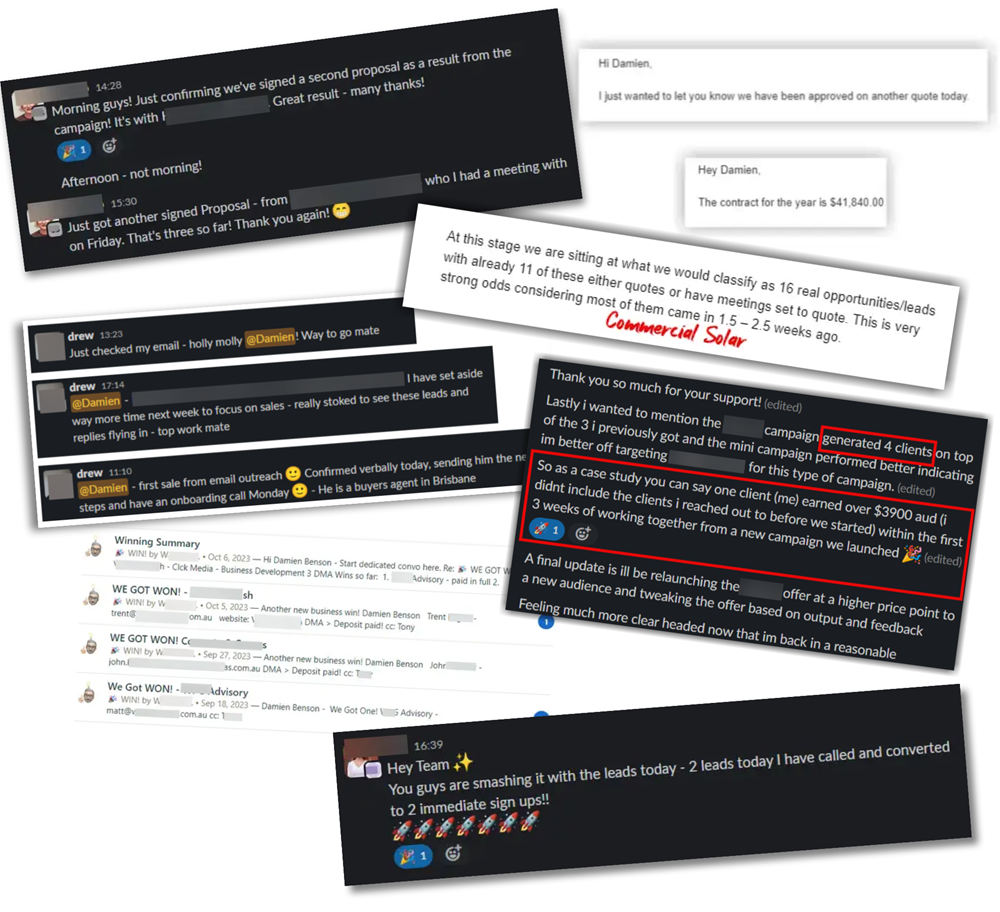
But over the past couple of years, the market shifted. The algorithms got tighter. Spam filters got smarter. Buyers grew blind to the pitches.
So we started testing LinkedIn. Not as a replacement, but as an evolution to where the highest-value conversations were already happening. And pretty quickly, we realised this was a different, much more premium game entirely.
LinkedIn's Biggest Weakness is Also its Biggest Strength
One of the reasons people steer away from LinkedIn and favour cold email or ads is the perception that LinkedIn doesn't support high-volume lead gen.
But this is exactly why it's such a brilliant channel for B2B service-based businesses like consultants, agencies, and commercial construction.
You are limited to sending around 200 connection requests per week on LinkedIn. Even with a strong acceptance rate of 50%, you're adding around 500 people per month to your first-degree network.
Now here's where it gets interesting...
You can freely message everyone who connects with you. Now, with AI and intelligent automation, you can message those 500 people with highly personalised insights relevant to their specific role and business.
For example, here are four real messages from a campaign I'm running right now:
"Noticed you head up [company] and thought this might be relevant.
Most project advisory firms tell us the challenge isn't delivering great work, it's keeping enough of the right clients coming through between engagements.
We offer a done-for-you LinkedIn outreach service where we get in front of your ideal clients on your behalf. Every message is personalised, we handle all the conversations, and you just get the interested prospects handed to you.
Any interest in taking a look at how this works?"
"Noticed you've built [company] for creators and thought this might land.
Most SaaS founders tell us enterprise sales feels like a different game when you've grown up doing product-led growth.
We offer a done-for-you LinkedIn outreach service where we reach out to your ideal clients on your behalf. Every message is personalised, we handle all the conversations, and you just get the interested prospects handed to you.
Worth a chat, or is your plate full right now?"
"Noticed you advise CEOs on sales performance at [company] and thought this might be relevant.
Most consultants in your space tell us the hardest part isn't delivering results, it's keeping a steady flow of the right CEO clients coming in.
We offer a done-for-you LinkedIn outreach service where we get in front of your ideal clients on your behalf. Every message is personalised, we handle all the conversations, and you just get the interested prospects handed to you.
Open to a quick conversation if the timing's right?"
"Noticed you're leading the ePTW implementation at [Company] and thought this might be relevant.
Most people rolling out permit to work systems say the tech is the straightforward part, getting the teams to actually use it consistently is where it gets tricky.
We offer a done-for-you LinkedIn outreach service where we get in front of your ideal clients on your behalf. Every message is personalised, we handle all the conversations, and you just get the qualified leads handed to you.
Worth a quick chat if you've got room to take on more work?"
Every message is different and references a specific pain point about their role, based on what we can find out from their LinkedIn profile.
It takes fine-tuning to ensure it sounds like a subtle observation a fellow business owner might relate to, rather than reciting facts about them like a Wikipedia article.
A couple of years ago, researching and writing 500 bespoke messages a month would have been a large part of a full-time SDR role costing $50k-$100k per year.
Now, with AI and proprietary workflows, we can research and craft hundreds of hyper-personalised messages in the time it used to take an SDR to write ten. We still cap our sends to a few hundred per month, because the goal is starting real, high-quality conversations, not breaking the internet.
AI also reads the replies we get and categorises them, alerting us when someone is actually interested. No more constantly checking inboxes for positive replies. AI sends a Slack message or an SMS as soon as someone actually wants to talk.
We only jump in when there's a specific question that needs a human touch or someone wants to book a meeting.
On LinkedIn, you're not landing in a spam folder. You're connecting with a real person, on a platform where they're already in "business mode." There is a fundamental level of trust built into the platform. But only if you know how to wield it.
We realised that standard lead-gen tactics instantly destroy your status. The moment you send a generic pitch, your prospect stops viewing you as a premium expert and lumps you in with every other desperate vendor.
To win, we had to completely abandon traditional outreach. We built an architecture where the heavy lifting happens entirely in the background, while your thought leadership is placed front and centre, establishing you as the premier authority before the prospect ever books a call.
We call it The Invisible Pipeline.
Here's what happens when you stop playing the numbers game and start writing messages that actually sound like a real person:
18,000+ LinkedIn connections built using this approach. 20-30% reply rate across thousands of messages (industry average sits around 5-8%). Dozens of clients signed directly from conversations where they were approached as a peer, not pitched as a vendor.
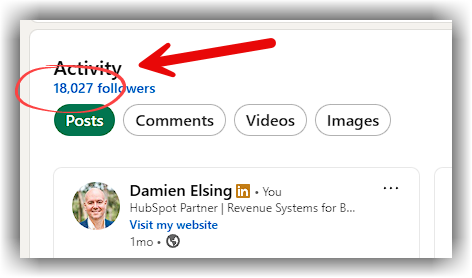
Our LinkedIn connection count, built entirely through this architecture.
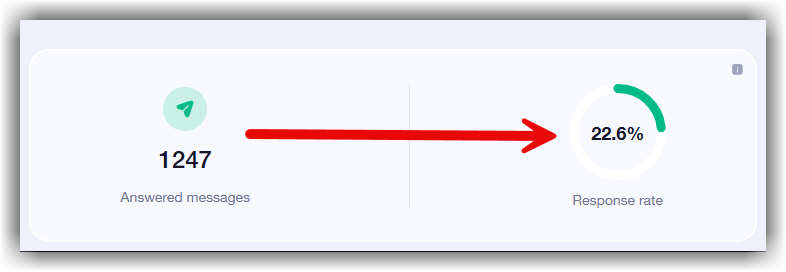
Campaign reply rate data. Industry average is 5-8%.
The 3 Things We Do Differently
We target people who are actually relevant
Most agencies pull a list of "CEOs in Sydney" and blast them all. That's not targeting. That's a phone book.
We build prospect lists using advanced boolean filters in LinkedIn Sales Navigator. We filter by role, industry, company size, location, and signals like recent hiring or expansion activity.
Importantly, we're able to EXCLUDE people who are not a fit with searches like this:
AND NOT ("Retail" OR "Store Manager")
The result is a list of decision-makers who actually have a reason to need what you sell. You're not wasting your precious connection bandwidth on people who don't have the budget or authority to buy from you.
You're not spamming 5,000 strangers. You're reaching 800-1,000 relevant people per month, in your industry, in your region, at the right seniority level.
Every message is custom-written for the person receiving it
This is the big one. Most outreach uses templates with merge fields. "Hi , I noticed you work at {}..." Everyone's seen it. Everyone ignores it.
We write a unique message for every single prospect. Not a template with their name swapped in. A message that references their actual role, their company, and the kind of work they'd realistically need.
Here's what that looks like in practice. These are real messages from a live campaign:
"Not sure if you handle the refurb side of things across the WDS venues, or if that sits with someone else?
We've done fit-outs for Stamford Hotel and Park Royal. Fixed price contracts, weekly photo updates. Happy to chat if you've got anything coming up."
"With the club, golf course, aquatic centre and cafe, I'd imagine you've got refurb work popping up fairly regularly. Do you handle that with a regular fit-out company or piece it together project by project?
We've done hospitality fit-outs for Stamford Hotel and Park Royal. Fixed price contracts, weekly photo updates. Happy to chat if it's useful."
Different people. Different messages. Each one written based on their role and company. That's what customisation looks like at scale.
We handle everything until they're ready to talk
You don't touch LinkedIn. You don't write messages. You don't manage follow-ups.
We run the entire campaign in the background using AI and automation, with human intervention where it counts. Connection requests go out daily. Follow-up messages are sent after someone accepts. When a prospect replies with interest, we notify you immediately via Slack, email, or SMS.
You step in when someone's ready to have a conversation. Not before.
And here's the part that compounds. Every month, this approach adds 300-500 targeted decision-makers to your LinkedIn network. That's your curated audience for everything you post and share from now on. Over 12 months, you've built a network of 4,000-6,000 relevant connections. That asset stays with you permanently, whether you keep working with us or not.
What this actually looks like in practice
Here's a handful of real replies from recent campaigns. These examples represent the standard outcome of establishing status equilibrium and deploying an Authority Pre-Frame.
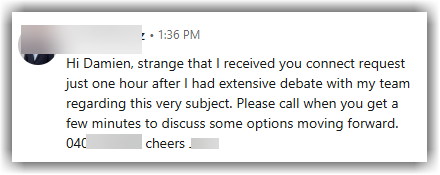
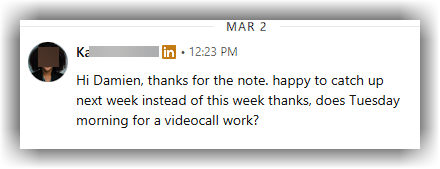
Rather than telling you to go away, these prospects engage with the thought leadership, ask high-level questions, and book calls as peers.
What this looks like when it's running:
You open Teams/Slack in the morning to a new qualified conversation. Your calendar has sales calls booked in advance. You're choosing which clients to work with instead of chasing anyone who'll talk to you. Your network is growing by hundreds of relevant connections every month. They see your posts, they see your name, and when they do need what you sell, you're the one they think of. That's what a working pipeline actually feels like.
One more thing
If you've read this far, you're probably in one of two camps.
You might be planning to implement this framework yourself, which is highly recommended. Everything above is exactly the framework we use.
Alternatively, you might recognise the value but lack the bandwidth to build and manage this consistently. We handle the targeting, we write the messages, we manage the daily incubation. You just take the calls.
The Guarantee: We guarantee 20+ replies from targeted decision-makers in your market every month, or we keep running until we hit it. Some will be ready to talk now. Some will be warm leads for later. All of them are people in your market who now know your name.
We're currently only taking on a small number of clients for this, so we can give each one proper attention.
No pressure. Takes about 2 minutes. If it's not a fit, the methodologies above should still help either way.